Training
Converting climb gradient to climb rate
A worked departure calculation showing how groundspeed changes the vertical speed required to meet a published climb gradient.
FlyHdg360 · · 3 min read
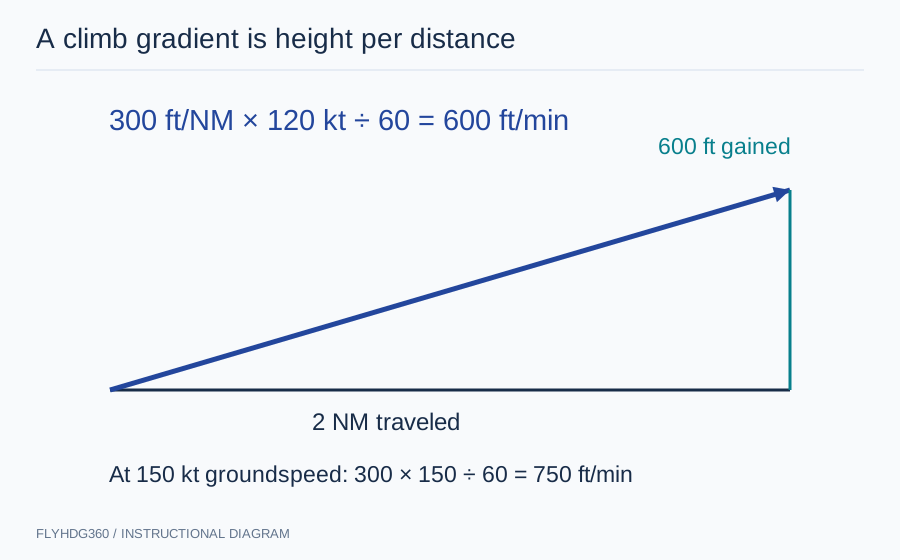
Feet per mile and feet per minute
A climb gradient describes height gained over horizontal distance. A climb rate describes height gained over time. The distinction matters because a vertical-speed indication alone does not establish compliance with a published gradient.
For a hypothetical departure requiring 300 feet per nautical mile, the required climb rate is 300 multiplied by groundspeed in nautical miles per minute. Knots are nautical miles per hour, so divide groundspeed by 60 before multiplying. The complete relationship is: required ft/min = required ft/NM × groundspeed in knots ÷ 60.
At 120 knots groundspeed, the aircraft travels 2 NM each minute. The calculation is 300 × 120 ÷ 60 = 600 ft/min. At 90 knots, it is 450 ft/min. At 150 knots, it is 750 ft/min. The required gradient has not changed; the time available to gain each increment of height has.
The effect of wind
For this distance-based calculation, use groundspeed rather than indicated airspeed. At a given true airspeed and track, a tailwind increases groundspeed. The airplane covers the departure path more quickly and must gain altitude faster to maintain the same gradient.
Suppose the planned climb rate is 600 ft/min. At 120 knots groundspeed it produces 600 × 60 ÷ 120 = 300 ft/NM. At 150 knots it produces only 240 ft/NM. The vertical-speed indication can remain unchanged while the climb gradient becomes insufficient.
Wind and true airspeed may change during the climb. A single groundspeed read near liftoff does not establish the requirement through the entire restricted segment. Evaluate the conditions expected along that segment using the applicable procedure and aircraft performance data.
Source: FAA AIM 5-4-21: Groundspeed and climb-gradient conversion
Compare the requirement with available performance
The conversion establishes the rate required by the selected gradient and groundspeed. It does not establish the airplane’s available rate of climb. Obtain that separately from the approved aircraft data for the planned weight, pressure altitude, temperature, configuration, and power setting.
A chart value of 650 ft/min compared with a calculated requirement of 600 ft/min leaves an arithmetic difference of 50 ft/min under the stated assumptions. That difference is not a general safety allowance. Changes in atmospheric conditions, weight, technique, aircraft condition, or the chart assumptions can consume it. Avoid reporting the calculation as a pass/fail aircraft approval without examining those assumptions.
Keep all-engine and engine-inoperative performance separate. Meeting a departure gradient with both engines operating does not demonstrate that a twin can meet it after losing an engine.
Source: FAA Airplane Flying Handbook, chapter 13: Multi-engine performance
Read the whole departure requirement
The published procedure supplies more than a number to enter in a calculator. Identify the runway, route, crossing restrictions, gradient, and the altitude or fix at which a nonstandard gradient ends. Also review obstacle notes and any conditions associated with an alternative.
The FAA’s standard departure criteria include assumptions about crossing the departure end of the runway, the initial turn, and the climb gradient. A calculation does not replace those lateral and vertical requirements. Do not stop climbing at the required gradient simply because the nearest visible obstacle is behind the airplane.
For a briefing, record the source of the required gradient, the expected groundspeed range, the calculated required rates, and the source and assumptions for available performance. This makes it possible to revise the calculation when the wind, weight, or departure clearance changes.
Source: FAA AIM 5-2-9: Departure obstacle-clearance assumptions