Training
DA, MDA, and the missed approach point
The different actions associated with decision altitude, minimum descent altitude, and an early missed approach.
FlyHdg360 · · 3 min read
Decision altitude
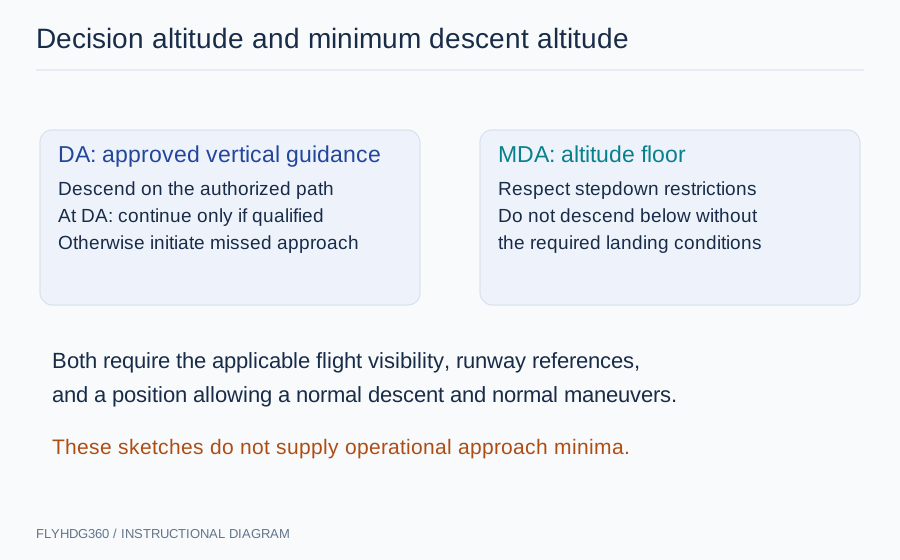
Decision altitude is associated with the decision to continue or execute the missed approach on the applicable vertically guided procedure. It is not an altitude at which to level off and wait for the runway to appear. Brief the required visual conditions and the missed approach before reaching it.
Use the line of minima appropriate to the approach, aircraft, and available equipment. The presence of a vertical indication on a display does not by itself identify that line. An RNAV chart can contain several lines of minima with different capabilities and altitude references.
When the conditions for continuing below DA are not satisfied, begin the missed approach at DA. The transition from descent to climb requires aircraft control and configuration changes; planning that transition is different from deliberately continuing the approach below its decision point.
Source: FAA AIM 5-4-5 and 5-4-21: Approach charts and missed approaches
Minimum descent altitude
Minimum descent altitude is a floor for the applicable portion of a nonprecision or circling approach unless the conditions for descent below it are met. Reaching MDA does not necessarily mean reaching the missed approach point. On a nonprecision final segment, the aircraft may reach MDA before the charted MAP.
For a hypothetical procedure with an MDA of 900 feet MSL and a separate MAP at a waypoint, arriving at 900 feet before that waypoint does not authorize an immediate missed-approach turn. The lateral path and the point at which a turn can begin still come from the procedure or an amended ATC clearance.
A technique that uses a continuous descent to MDA must still respect the published altitude limit and the conditions for going below it. Advisory vertical guidance is not permission to substitute a lower DA for the published MDA.
Source: FAA AIM 5-4-5: RNAV minima and procedure requirements
Conditions for continuing below the minimum
A runway appearing in the distance is not the entire determination. The applicable rule addresses the aircraft’s position for a normal descent and landing, required flight visibility, and the specified visual references. These are separate conditions; satisfying one does not remove the others.
Approach-light references have limitations under the rule. Do not teach or brief “any lights in sight” as unrestricted permission to descend to the runway. Read the applicable provisions of 14 CFR 91.175 together with the charted minima and notes.
A forecast used to decide whether an alternate is required is also a separate matter. It does not establish the actual flight visibility or visual references needed to continue an approach at the destination.
Source: FAA AIM 5-4-20 and referenced 14 CFR 91.175: Landing minimums
An early missed approach does not authorize an early turn
The FAA explains that missed-approach obstacle protection assumes initiation at DA/DH or at the MAP no lower than MDA, with the required climb performance. It does not provide an unrestricted area for a turn whenever the pilot decides to discontinue the approach.
If executing an early missed approach, continue along the specified approach path to the MAP at or above the applicable minimum before making the missed-approach turn, unless ATC has cleared a different procedure. Comply with any intervening altitude restrictions. Separate the decision to stop descending from the authorization to change the lateral path.
A rejected landing after passing the MAP or descending below the minimum is a different geometry. Following the published missed-approach track from that position does not automatically reproduce the procedure’s obstacle protection. Brief that possibility before starting the approach, particularly when terrain or limited climb performance restricts the options.
Source: FAA AIM 5-4-21: Early missed approaches and rejected landings