Training
VMC and VYSE: control and climb performance
The red line and blue line describe different characteristics. Neither replaces aircraft-specific engine-inoperative performance planning.
FlyHdg360 · · 3 min read
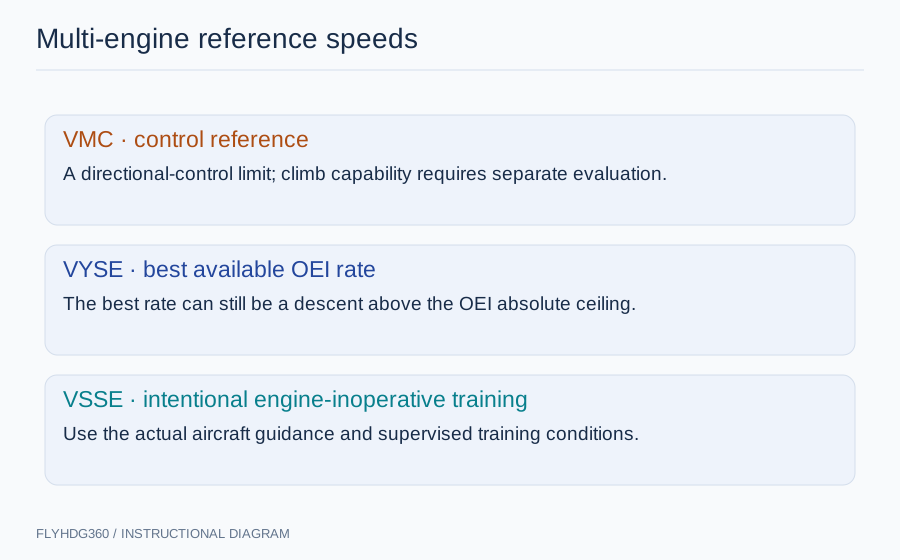
VMC is a directional-control value
Published VMC is established under specified conditions with the critical engine inoperative. It addresses the ability to maintain directional control against asymmetric thrust. It does not state that the airplane can hold altitude or clear an obstacle.
The airspeed marking is fixed, but the operating conditions are not. Power, configuration, center of gravity, bank, and the state of the inoperative propeller affect the control problem. Treat the published value as part of the aircraft’s limitations and performance documentation, not as a universal boundary that makes every condition above it safe.
A stall is a separate aerodynamic limit. The wing can reach its critical angle of attack while the pilot is concentrating on directional control. A VMC demonstration therefore requires aircraft-specific procedures, suitable conditions, and qualified instruction; the purpose of a written explanation is to understand the relationships, not to prescribe a self-taught flight exercise.
VYSE identifies a speed, not a guaranteed result
VYSE is the best single-engine rate-of-climb speed for the applicable conditions. Whether the resulting vertical speed is positive depends on available performance. At an altitude where the airplane cannot maintain height on one engine, selecting the appropriate speed does not create additional power.
Climb performance depends on excess power: the power available beyond what is required to maintain the flight condition. After an engine failure, a substantial portion of the remaining engine’s power may be required simply to sustain flight. The reduction in climb capability can therefore be much greater than the percentage reduction in installed engine power.
A pilot needs both the relevant speed and the performance prediction. A study answer that stops at “fly blue line” leaves out the information needed to evaluate terrain, route, weather, and aircraft loading.
Source: FAA Airplane Flying Handbook, chapter 13: Engine-inoperative flight principles
Convert a positive climb into a gradient
Consider a hypothetical prediction of 180 ft/min at 100 knots groundspeed. The corresponding gradient is 180 × 60 ÷ 100 = 108 ft/NM. If a hypothetical departure segment requires 200 ft/NM, the aircraft is climbing but does not meet that requirement under the stated conditions.
At 120 knots groundspeed, the same 180 ft/min produces 90 ft/NM. The calculation uses groundspeed because obstacles are located along the ground track. It is not a recommendation to change the aircraft’s prescribed engine-inoperative airspeed to improve the arithmetic.
Keep the units visible when comparing a performance chart with a procedure. A value in feet per minute cannot be compared directly with a requirement in feet per nautical mile.
Source: FAA AIM 5-4-21: Climb rate, gradient, and groundspeed
Configuration is part of the prediction
A performance chart’s result applies to its stated configuration. Gear and flap position, propeller condition, power setting, speed, weight, and atmospheric conditions are not optional details beneath the graph. Record them with the result.
A chart assuming a feathered propeller does not establish the same performance while the propeller is windmilling. Likewise, a clean-configuration result does not describe the drag and performance during every phase of an engine-failure response. Use the aircraft’s actual procedures and data to understand the transition.
Before multi-engine training, prepare a study sheet with separate entries for the control-related speeds, best single-engine climb speed, relevant configurations, and predicted performance. Identify the source for each value. Keep model-specific limits out of a generic checklist until they have been checked against the aircraft you will fly.
Source: FAA Airplane Flying Handbook, chapter 13: Configuration and performance