Module lessons (4)
Flight controls and the three axes
The longitudinal axis runs nose to tail; roll is rotation about it. Ailerons primarily control roll. The lateral axis runs wingtip to wingtip; pitch is rotation about it and is primarily controlled by the elevator or stabilator. The vertical axis runs through the aircraft from top to bottom; yaw is rotation about it and is primarily controlled by the rudder.
Control effects interact. Aileron deflection can produce adverse yaw because the wings experience unequal drag while initiating a roll. Rudder coordinates the resulting motion. It does not substitute for elevator control of angle of attack or maintain altitude by itself in a steep turn.
Flaps change wing camber and, on some designs, wing area. They increase available lift at a given angle of attack over part of the operating range and also increase drag. Slats and slots alter airflow near the leading edge and can delay separation to a higher angle of attack. Spoilers disrupt lift and increase drag. Trim adjusts the force needed to hold a condition; the pilot establishes the condition with the primary controls before trimming.
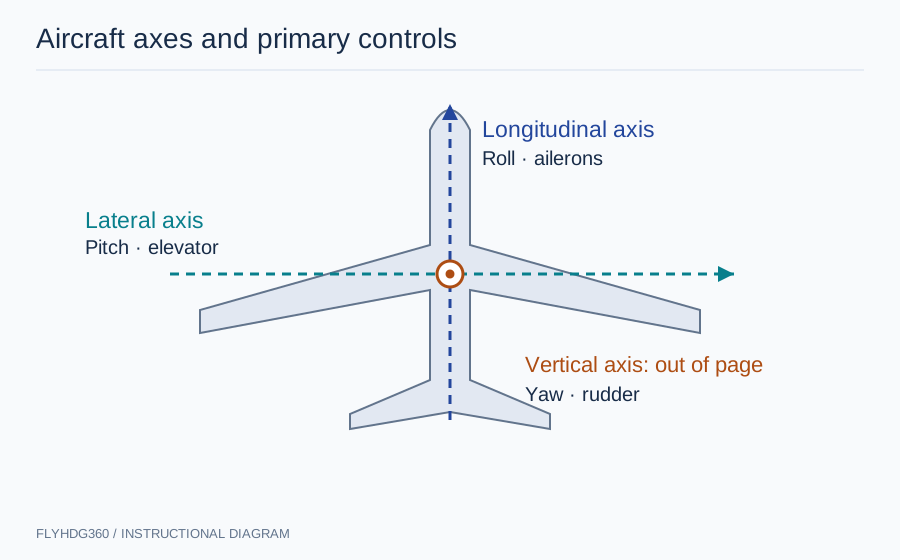
Axes pass through the center of gravity. Conventional control names are shown; some aircraft combine control functions.
Aircraft documents and operating limitations
An airworthy aircraft conforms to its approved type design, including applicable modifications and directives, and is in condition for safe operation. The PIC must determine that the aircraft is in condition for safe flight and discontinue flight when unairworthy mechanical, electrical, or structural conditions occur. A recently signed annual inspection does not negate a defect discovered today.
Section 91.203 requires the applicable airworthiness certificate and effective registration certificate aboard a civil aircraft, with the airworthiness certificate displayed as specified. Operating limitations include the approved flight manual when required, markings, placards, and other prescribed limitations. A generic handbook for the same model does not necessarily contain the supplements or limitations for an individual aircraft.
Registration currently has a seven-year duration under § 47.40, subject to termination and other conditions. A standard airworthiness certificate has continuing-effectiveness conditions in § 21.181 rather than a routine annual expiration date. The annual inspection is a separate operating requirement.
Aircraft weight-and-balance records establish the current empty weight, moment, and equipment configuration from which loading is calculated. They must correspond to the actual aircraft. A radio station license is an international-operations consideration rather than a universal domestic ARROW-document requirement. Requirements for a particular foreign destination need separate verification.
Annual and 100-hour inspections
For an aircraft subject to the ordinary annual-inspection rule, the annual must have occurred within the preceding 12 calendar months. A January 2026 annual normally remains within that interval through January 31, 2027. Progressive and other inspection programs have different provisions; identify which program applies to the aircraft.
The 100-hour rule applies to carrying a person other than a crewmember for hire, and to flight instruction for hire when the person giving instruction provides the aircraft. It does not attach simply because a paid instructor sits in an owner’s aircraft. An annual can satisfy a required 100-hour inspection, but a 100-hour inspection does not substitute for an annual unless performed and recorded as an annual by an appropriately authorized person.
The 100-hour interval may be exceeded by no more than 10 hours while en route to a place where the inspection can be done; that excess counts toward the next 100 hours. This is not a discretionary 110-hour operating interval. An aircraft outside an inspection requirement cannot simply be flown to a shop on the assumption that it is safe. A special flight permit, where applicable, has a defined purpose, conditions, and approval process.
Avionics, static-system, and ELT checks
A VOR operational check is required within the preceding 30 days for IFR operation using the VOR system. Section 91.171 permits several methods with different tolerances. It is not a general requirement for every VFR flight or every IFR flight using another approved navigation system. The navigation module explains the indications and log entry.
For IFR operation in controlled airspace, § 91.411 generally requires the static-pressure system, altimeter instruments, and automatic pressure-altitude reporting system to have been tested and inspected within the preceding 24 calendar months, with additional provisions after specified work. Section 91.413 separately addresses transponder tests within 24 calendar months before use. A pitot-system visual check during preflight does not replace these inspections.
An installed ELT subject to § 91.207 must be inspected within 12 calendar months for installation, battery corrosion, controls and crash sensor, and sufficient signal. Its battery must be replaced or recharged after more than one cumulative hour of transmitter use, or when 50 percent of its useful life or charge life has expired as established by the manufacturer. Annual inspection and battery expiration are separate items. Follow the ELT’s approved test procedure; a routine self-test of a 406-MHz unit is not the same as deliberately transmitting a distress alert.
Required equipment and inoperative items
Section 91.205 specifies equipment for powered civil aircraft with standard-category U.S. airworthiness certificates under the operating conditions stated in the rule. Day-VFR requirements include an airspeed indicator, altimeter, magnetic direction indicator, and the applicable engine, fuel, landing-gear, restraint, and other equipment. Several requirements depend on the aircraft’s systems or certification date; a mnemonic can omit those conditions.
Night VFR adds requirements including approved position lights, an approved aviation red or white anticollision light system, an adequate electrical energy source, spare fuses when applicable, and an electric landing light if operated for hire. Section 91.209 separately governs use of aircraft lights.
When no approved minimum equipment list is being used, § 91.213(d) provides an inoperative-equipment path only for the aircraft and circumstances it covers. Determine whether the item is required by the type-certification basis for VFR day, the aircraft equipment list or kinds-of-operations equipment list for the operation, § 91.205 or another rule, or an airworthiness directive. An item required by one of those sources is not made optional by an INOPERATIVE placard.
If the rule permits deferral, the item must be removed or deactivated and placarded as required, with maintenance performed and recorded when applicable. An appropriately rated pilot or authorized maintenance person must determine that the inoperative item is not a hazard. Pulling an unidentified circuit breaker can disable other equipment and does not establish compliance.
A failed landing light
- A private owner proposes a day-VFR flight with an inoperative landing light. Section 91.205’s night-for-hire landing-light requirement is not, by itself, a reason the light is required for this flight.
- The review still must cover the aircraft equipment list or KOEL, certification requirements, ADs, other rules, and the applicability of § 91.213(d).
- Only after the required deactivation or removal, placarding, records, and hazard determination may the item be treated as a permitted deferral. “Daytime” alone is not a complete dispatch decision.
Accident notification and preservation of evidence
NTSB notification and written reporting are different obligations under 49 CFR Part 830. An aircraft accident, an overdue aircraft believed to have been involved in an accident, and the specific serious incidents listed in § 830.5 require immediate notification by the most expeditious means available. The operator must evaluate the actual event against that list; the absence of an injury does not make every incident nonreportable.
The accident definition concerns the period from boarding with the intention of flight until all such persons have disembarked, when a person suffers death or serious injury or the aircraft receives substantial damage. Substantial damage is defined by its effect on structural strength, performance, or flight characteristics and the repair normally required. The regulation lists exclusions, including certain damage limited to an engine, bent fairings, small skin punctures, ground damage to propeller blades, and damage to landing gear, wheels, tires, flaps, engine accessories, brakes, or wingtips. An exclusion is not permission to ignore other damage or a separately reportable incident.
Under § 830.15, an accident report is due within 10 days; an overdue aircraft still missing requires a report after seven days. An incident report is filed when an authorized NTSB representative requests it. Immediate notification should not be delayed until a written report is complete. Section 830.6 specifies the information to provide when available.
Preserve wreckage, records, and recording media under § 830.10. Before NTSB custody or release, movement is limited to the stated needs such as rescuing injured persons, protecting the wreckage from further damage, or protecting the public. When movement is necessary, document the original positions and condition as the rule requires. Emergency rescue and fire response remain the first immediate concerns.
Worked review: an inoperative item is a decision process
Airworthiness combines conformity to the applicable approved design with a condition for safe operation. A current annual inspection is evidence of a required inspection; it is not a guarantee that no defect has developed since that inspection. The PIC must evaluate the aircraft’s present condition and discontinue a flight when an unairworthy mechanical, electrical, or structural condition occurs.
For an aircraft using the § 91.213(d) route rather than an approved MEL, the equipment decision starts before removal, deactivation, or placarding. Determine whether the item is required by the applicable type-certification basis, the equipment list or kinds-of-operations equipment list, the operating rules for the intended flight, or an airworthiness directive. If a requirement applies, a placard alone does not make the operation permissible.
Consider a failed electric landing light in an airplane proposed for a night operation for hire. Section 91.205(c) includes that light for the applicable operation. For another operation, the same item might not be required by that particular rule, but the remaining § 91.213 checks still apply. The pilot cannot stop after finding one regulation that does not require it. Any required maintenance action, record entry, and no-hazard determination must also be completed by the appropriate person.
After an occurrence, the maintenance decision and the NTSB reporting decision remain separate. An aircraft may need repair even when the occurrence does not satisfy the accident definition. Conversely, a serious incident listed in Part 830 may require immediate notification despite limited visible damage. Preserve records and evaluate the actual event against the reporting rule.
Check your understanding
A pilot finds an inoperative item, switches it off, and labels it INOPERATIVE. What evidence is still needed before deciding to fly?
Answer and explanation
- Determine the applicable operating basis: approved MEL or the conditions of § 91.213(d).
- Check every applicable equipment requirement, including approved aircraft documents, operating rules, and airworthiness directives.
- Determine the required removal or deactivation, maintenance authorization and record entries, and whether the inoperative item creates a hazard. A label does not perform those checks.
Module assignment
Prepare a document-and-inspection review for a specific training aircraft. Record the certificate and rating required, pilot review and currency dates, registration status, applicable operating limitations, annual and any 100-hour due times, ELT inspection and battery dates, and avionics checks relevant to the intended operation. For one inoperative item, identify every requirement checked and the disposition supported by § 91.213 and the aircraft documents. Do not invent missing maintenance dates.