By the end of this lesson
- Identify the documents and endorsements required to exercise private-pilot privileges.
- Calculate flight-review and passenger-currency dates.
- Explain the primary controls and distinguish their axes.
- Evaluate aircraft documents, inspections, and an inoperative-equipment discrepancy.
Module lessons (4)
Certificates, ratings, and endorsements
A private pilot certificate identifies privileges; its category and class ratings identify the aircraft in which those privileges may be exercised. Airplane is a category. Single-engine land is a class. A type rating is a separate qualification required for specified aircraft, including large aircraft and turbojet-powered airplanes, subject to the regulation’s exceptions. A tailwheel endorsement is not a class rating.
For private pilot airplane eligibility under Part 61, an applicant must be at least 17, meet the English-language requirement, receive the required training and endorsements, and pass the knowledge and practical tests. Section 61.109(a) sets the airplane single-engine minimum at 40 hours, including at least 20 hours of specified instruction and 10 hours of specified solo flight. These are minimum experience requirements, not a prediction of the time an individual will need.
The single-engine training includes 3 hours of cross-country instruction; 3 hours of night instruction including a cross-country flight over 100 NM total distance and 10 takeoffs and 10 full-stop landings, each landing involving a traffic pattern; 3 hours solely by reference to instruments; and 3 hours of practical-test preparation within the preceding 2 calendar months from the month of the test. The rule provides specific exceptions and crediting provisions.
The 10-hour solo requirement includes at least 5 hours of solo cross-country time, one 150-NM-total cross-country with full-stop landings at three points and one segment more than 50 NM straight-line between takeoff and landing, and three takeoffs and three full-stop landings with traffic patterns at an airport with an operating control tower. Record each requirement separately against § 61.109(a); 40 total hours without the required experience does not establish eligibility.
Section 61.3 generally requires the appropriate pilot certificate, government-issued photo identification, and applicable medical documentation in the pilot’s physical possession or readily accessible in the aircraft. A temporary airman certificate has its own expiration and termination conditions. Additional training and endorsements may be required for complex, high-performance, tailwheel, or specified pressurized airplanes under § 61.31.
Medical eligibility and fitness for flight
A third-class medical certificate is a common way to meet medical requirements for private-pilot operations. For those privileges, an examination taken before age 40 is generally valid through the end of the 60th calendar month after the examination month; an examination taken at age 40 or older generally supports those privileges through the end of the 24th calendar month. The pilot’s age on the examination date controls that distinction.
BasicMed is an alternative for eligible pilots and operations, not a replacement medical certificate. It involves medical history and eligibility requirements, a physician examination, an approved education course, and operating limits. Current § 61.113(i) permits qualifying aircraft authorized for no more than seven occupants and a maximum certificated takeoff weight no more than 12,500 pounds, with no more than six passengers; additional conditions include operations at or below 18,000 feet MSL, no more than 250 KIAS, and geographic and compensation restrictions. Check §§ 61.23, 61.113 and Part 68 together rather than applying an older 6,000-pound summary.
Medical paperwork does not establish fitness on a particular day. Section 61.53 addresses known medical deficiencies. IMSAFE organizes illness, medication, stress, alcohol, fatigue, and emotion; each item concerns actual impairment or eligibility. Sedating medications, hypoxia, sleep loss, and illness can impair judgment before the pilot recognizes a handling problem. Medication questions require the specific drug, dose, condition, and applicable FAA medical guidance.
Section 91.17 prohibits acting or attempting to act as a crewmember within 8 hours after consuming alcohol, while under its influence, while using a drug that affects faculties contrary to safety, or with an alcohol concentration of 0.04 or greater. Passing the eight-hour threshold does not override the other restrictions.
Flight review and passenger currency
A flight review normally includes at least 1 hour of ground training and 1 hour of flight training, with a satisfactory endorsement from an authorized instructor. To act as PIC, the review or a qualifying alternative must fall within the preceding 24 calendar months. Specified practical tests, proficiency checks, and completion of a phase of the FAA WINGS program can satisfy alternatives in § 61.56; merely attending a safety seminar does not establish completion of a WINGS phase.
Passenger currency is a separate requirement. Under § 61.57(a), the pilot must have made at least three takeoffs and three landings in the preceding 90 days as sole manipulator of the controls in the same category, class, and type when a type rating is required. For tailwheel airplanes, the landings must be to a full stop.
To carry passengers during the period from 1 hour after sunset to 1 hour before sunrise, the required three takeoffs and three full-stop landings must have occurred during that period within the preceding 90 days. The passenger-currency window is not the same definition used to log night time or determine when position lights are required. A current flight review does not restore passenger currency, and current passenger landings do not replace a flight review.
Calendar months versus days
- A flight review completed on March 12, 2026 normally supports PIC operations through March 31, 2028, unless another requirement or disqualification intervenes.
- Passenger currency uses a rolling 90-day interval. It does not run to the end of the third calendar month.
- A pilot who has a valid review but no qualifying landings in that interval cannot carry passengers under the ordinary currency rule.
Student solo privileges and private-pilot limitations
Student solo flight requires the applicable pre-solo knowledge test, flight training, demonstrated proficiency, and instructor endorsements. A solo endorsement is specific to the make and model and has a 90-day recency requirement. Solo cross-country privileges have additional training and endorsement requirements under § 61.93. Instructor limitations in the endorsement remain binding even when general VFR weather minima would permit flight.
A student pilot may not carry a passenger or operate for compensation or hire. Private pilots also face compensation and expense-sharing restrictions. Section 61.113 permits only specified exceptions to the general prohibition on acting as PIC for compensation or hire. Sharing permitted operating expenses does not authorize an air-transportation business: the pilot must pay at least the pro rata share of fuel, oil, airport expenses, and rental fees, and the operation must satisfy the other applicable legal requirements.
The knowledge test, course completion record, and practical-test endorsement serve different purposes. This course records study and quiz results. An authorized instructor must make any required training determination and issue the appropriate endorsement; a software score does not make that determination.
Aeronautical decision-making and human limitations
PAVE groups hazards by pilot, aircraft, environment, and external pressures. Its purpose is to identify interacting limits: for example, high density altitude reduces climb performance while a heavy load increases the required takeoff distance. A deadline can influence the decision to accept both. Under § 91.3, the PIC is directly responsible for and has final authority over the aircraft’s operation.
Hypoxia is inadequate oxygen delivery to tissues. Altitude reduces oxygen partial pressure even though the atmosphere’s oxygen proportion remains approximately the same. Carbon monoxide impairs oxygen carriage in blood; exhaust-system defects can introduce it into a cabin. Headache, dizziness, and degraded thinking are not specific enough to identify a single cause in flight. The aircraft’s emergency procedure and prompt reduction of exposure take priority over trying to diagnose symptoms from memory.
The vestibular system can create a convincing false sense of attitude without reliable visual references. Instrument indications, cross-checked for failures, provide attitude information when outside references are unavailable. A private-pilot certificate alone does not authorize IFR flight. The three hours of instrument-reference training in the private syllabus are not an instrument rating.
Preflight action under § 91.103 includes all available information concerning the flight. For flights away from an airport’s vicinity, that specifically includes weather reports and forecasts, fuel requirements, alternatives if the planned flight cannot be completed, and known ATC delays. Runway lengths and applicable takeoff and landing performance information are required considerations for every flight.
Hypoxia and hyperventilation
Hypoxia means insufficient oxygen at the tissues. In hypoxic hypoxia, reduced oxygen pressure at altitude limits transfer into the blood. Hypemic hypoxia involves reduced oxygen-carrying capacity, as with carbon monoxide exposure or anemia. Stagnant hypoxia involves inadequate blood flow. Histotoxic hypoxia occurs when cells cannot use the oxygen delivered to them. These mechanisms explain why altitude alone does not determine a pilot’s susceptibility.
Headache, impaired judgment, slowed responses, poor coordination, and euphoria can occur before a pilot recognizes a problem. Feeling unusually comfortable is not evidence of adequate oxygen. Night vision is particularly sensitive. Oxygen equipment must deliver oxygen through the correct device at a suitable flow; an empty bottle, disconnected hose, or inappropriate cannula can defeat the intended protection. Follow the aircraft and oxygen-system procedures and descend to a safe lower altitude when oxygenation is in doubt.
Hyperventilation is breathing in excess of metabolic need, reducing carbon dioxide in the blood. Anxiety, pain, or stress can trigger it. Tingling, dizziness, visual disturbance, and impaired coordination overlap with hypoxia symptoms. Conscious control of breathing and speaking aloud can help restore a normal breathing pattern. If symptoms occur while using oxygen, check and use the oxygen system appropriately before assuming the cause is hyperventilation. Do not remove needed oxygen to test that assumption.
Section 91.211 establishes minimum supplemental-oxygen requirements using cabin pressure altitude and exposure time. The legal thresholds are not physiological guarantees. Illness, smoking, fatigue, and individual response may impair performance below a regulatory threshold. An oxygen saturation display is an additional observation; it does not measure judgment or eliminate the need to respond to symptoms.
Carbon monoxide and cabin heat
Carbon monoxide is a colorless, odorless gas produced by incomplete combustion. It binds strongly to hemoglobin and reduces oxygen transport. In a piston trainer with an exhaust-shroud cabin heater, a defect in the exhaust system can introduce exhaust gases into heated cabin air. Exhaust odor may accompany a leak, but absence of an odor does not rule out carbon monoxide.
Headache, nausea, dizziness, unusual fatigue, or confusion affecting more than one occupant should raise concern about cabin contamination. A detector alarm deserves action even before symptoms occur. Use the aircraft’s checklist: isolate the suspected source, introduce fresh air as directed, use supplemental oxygen if available, and land as soon as practical under the circumstances. Impairment can progress while the pilot is troubleshooting.
A conventional two-wavelength pulse oximeter can give a misleadingly reassuring reading during carbon monoxide exposure. It is not a substitute for a CO detector or medical evaluation. After a suspected exposure, arrange medical assessment and have the aircraft’s source of contamination investigated before returning it to service. Record the symptoms, detector indication, heater configuration, and time rather than simply writing ‘heater problem.’
Pressure changes: ears, sinuses, and scuba diving
The middle ear must equalize with ambient pressure through the eustachian tube. During descent, rising cabin pressure can produce a painful pressure difference if congestion prevents air from entering the middle ear. Sinus openings can become obstructed in the same way. An upper respiratory infection or allergy can therefore create an operational problem even when the pilot feels capable of performing ordinary tasks on the ground.
Swallowing or yawning may help normal equalization. Severe pain, vertigo, or inability to equalize requires attention to flight control and a change in the descent plan compatible with terrain and ATC. Decongestants do not reliably make an obstructed ear safe for flight and may themselves impair performance. Persistent symptoms after landing require medical advice.
Scuba diving increases dissolved nitrogen in body tissues. Reduced pressure during a subsequent flight can permit gas bubbles to form. The FAA recommends at least 12 hours before flight up to 8,000 feet MSL after a dive without decompression stops, and at least 24 hours after a dive requiring decompression stops. Above 8,000 feet MSL, the recommendation is at least 24 hours after any scuba dive. These recommendations apply to actual flight altitude, not merely the expected pressurized cabin altitude. They are FAA guidance, not a guarantee for an individual dive profile; more restrictive diving or medical guidance still matters.
Spatial disorientation and motion sickness
The vestibular system senses acceleration, not an unambiguous aircraft attitude. A prolonged constant-rate turn can cease to feel like a turn. Rolling level may then feel like a turn in the opposite direction. Moving the head during a turn can stimulate more than one semicircular canal and produce a strong tumbling sensation. These sensations can conflict with functioning flight instruments.
The leans can follow a slow, unnoticed bank and a subsequent corrective roll. A graveyard spiral develops when a pilot accepts a banked descent as normal and pulls to recover altitude without first correcting bank; the pull tightens the descending turn. Acceleration can also create a nose-up sensation, especially without a reliable horizon, encouraging an inappropriate forward control input. A dark departure over unlighted terrain can remove visual attitude information even when the weather is legally VFR.
Instrument cross-check and trained control technique provide a usable attitude reference when outside cues are inadequate. Do not attempt to resolve conflicting sensations by following the sensation that feels strongest. An instrument indication must also be evaluated for failure using independent information. The private pilot’s basic instrument training is a means of developing limited control skills; it does not provide an instrument rating.
Motion sickness can produce pallor, sweating, nausea, and reduced attention. Minimize unnecessary head movement, improve ventilation when appropriate, and use a stable outside reference when one is available. Transfer control to a qualified pilot if necessary and end the flight when symptoms interfere with safe performance. Many motion-sickness medicines cause sedation; a passenger’s remedy is not automatically acceptable for a pilot.
Fatigue, stress, dehydration, and temperature
Acute fatigue follows a period of physical or mental effort; chronic fatigue develops when repeated demands exceed recovery. Both can reduce attention, working memory, coordination, and the ability to detect one’s own errors. A pilot who repeatedly rereads a clearance, omits familiar checks, or cannot maintain a coherent fuel calculation has operational evidence of reduced capacity. Caffeine can change alertness temporarily without replacing sleep.
Stress consumes attention even when its cause is unrelated to flying. Time pressure, financial concerns, and interpersonal conflict can combine with weather and aircraft workload. In single-pilot resource management, reducing unnecessary tasks is a practical response: load and verify navigation before taxi, obtain assistance from ATC, defer nonessential programming, and select an earlier landing. An urgent schedule is not additional aircraft capability.
Dehydration and inadequate nutrition can impair physical and mental performance. Hot cabins, long flights, and deliberate restriction of fluids to avoid a restroom stop can contribute. Carry accessible water, plan stops, and account for the occupants’ needs. Heat illness can include weakness, headache, nausea, and confusion; continuing a flight while symptoms worsen reduces the ability to manage the aircraft.
Hypothermia occurs when heat loss exceeds the body’s ability to maintain temperature. Shivering, reduced dexterity, and slowed thinking can make simple tasks difficult. Appropriate clothing matters before a forced landing, particularly over cold terrain or water. Cabin comfort does not predict survival conditions outside. Survival supplies belong in the weight-and-balance calculation and must be reachable after an evacuation.
Alcohol, medication, and fitness for duty
Section 91.17 prohibits acting or attempting to act as a crewmember within eight hours after consuming alcohol, while under its influence, while using a drug that affects faculties contrary to safety, or with a blood or breath alcohol concentration of 0.04 or greater. These are separate conditions. Waiting eight hours does not establish legality if the pilot remains impaired or above the concentration limit.
A prescription does not by itself establish that a medication is compatible with flying. The underlying illness and the medicine each need consideration. Sedating antihistamines, sleep aids, some pain medicines, and other over-the-counter products can affect attention and coordination. Combination cold remedies may contain several active ingredients. Read the label and obtain appropriate aviation medical advice rather than inferring acceptability from the product’s availability without a prescription.
Section 61.53 addresses operation during a medical deficiency. A medical certificate’s printed expiration does not authorize flight through a disqualifying condition. The applicable standard depends on the certification basis, including the provisions governing operations without a medical certificate. Do not change or stop prescribed treatment solely to meet a flying schedule; resolve treatment and flight eligibility with the appropriate clinician and aviation medical guidance.
Flight controls and the three axes
The longitudinal axis runs nose to tail; roll is rotation about it. Ailerons primarily control roll. The lateral axis runs wingtip to wingtip; pitch is rotation about it and is primarily controlled by the elevator or stabilator. The vertical axis runs through the aircraft from top to bottom; yaw is rotation about it and is primarily controlled by the rudder.
Control effects interact. Aileron deflection can produce adverse yaw because the wings experience unequal drag while initiating a roll. Rudder coordinates the resulting motion. It does not substitute for elevator control of angle of attack or maintain altitude by itself in a steep turn.
Flaps change wing camber and, on some designs, wing area. They increase available lift at a given angle of attack over part of the operating range and also increase drag. Slats and slots alter airflow near the leading edge and can delay separation to a higher angle of attack. Spoilers disrupt lift and increase drag. Trim adjusts the force needed to hold a condition; the pilot establishes the condition with the primary controls before trimming.
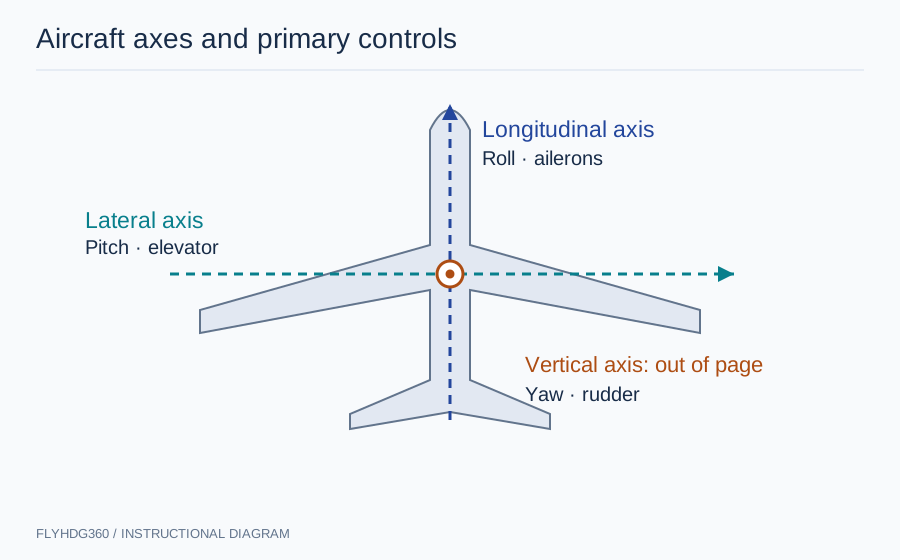
Axes pass through the center of gravity. Conventional control names are shown; some aircraft combine control functions.
Aircraft documents and operating limitations
An airworthy aircraft conforms to its approved type design, including applicable modifications and directives, and is in condition for safe operation. The PIC must determine that the aircraft is in condition for safe flight and discontinue flight when unairworthy mechanical, electrical, or structural conditions occur. A recently signed annual inspection does not negate a defect discovered today.
Section 91.203 requires the applicable airworthiness certificate and effective registration certificate aboard a civil aircraft, with the airworthiness certificate displayed as specified. Operating limitations include the approved flight manual when required, markings, placards, and other prescribed limitations. A generic handbook for the same model does not necessarily contain the supplements or limitations for an individual aircraft.
Registration currently has a seven-year duration under § 47.40, subject to termination and other conditions. A standard airworthiness certificate has continuing-effectiveness conditions in § 21.181 rather than a routine annual expiration date. The annual inspection is a separate operating requirement.
Aircraft weight-and-balance records establish the current empty weight, moment, and equipment configuration from which loading is calculated. They must correspond to the actual aircraft. A radio station license is an international-operations consideration rather than a universal domestic ARROW-document requirement. Requirements for a particular foreign destination need separate verification.
Annual and 100-hour inspections
For an aircraft subject to the ordinary annual-inspection rule, the annual must have occurred within the preceding 12 calendar months. A January 2026 annual normally remains within that interval through January 31, 2027. Progressive and other inspection programs have different provisions; identify which program applies to the aircraft.
The 100-hour rule applies to carrying a person other than a crewmember for hire, and to flight instruction for hire when the person giving instruction provides the aircraft. It does not attach simply because a paid instructor sits in an owner’s aircraft. An annual can satisfy a required 100-hour inspection, but a 100-hour inspection does not substitute for an annual unless performed and recorded as an annual by an appropriately authorized person.
The 100-hour interval may be exceeded by no more than 10 hours while en route to a place where the inspection can be done; that excess counts toward the next 100 hours. This is not a discretionary 110-hour operating interval. An aircraft outside an inspection requirement cannot simply be flown to a shop on the assumption that it is safe. A special flight permit, where applicable, has a defined purpose, conditions, and approval process.
Avionics, static-system, and ELT checks
A VOR operational check is required within the preceding 30 days for IFR operation using the VOR system. Section 91.171 permits several methods with different tolerances. It is not a general requirement for every VFR flight or every IFR flight using another approved navigation system. The navigation module explains the indications and log entry.
For IFR operation in controlled airspace, § 91.411 generally requires the static-pressure system, altimeter instruments, and automatic pressure-altitude reporting system to have been tested and inspected within the preceding 24 calendar months, with additional provisions after specified work. Section 91.413 separately addresses transponder tests within 24 calendar months before use. A pitot-system visual check during preflight does not replace these inspections.
An installed ELT subject to § 91.207 must be inspected within 12 calendar months for installation, battery corrosion, controls and crash sensor, and sufficient signal. Its battery must be replaced or recharged after more than one cumulative hour of transmitter use, or when 50 percent of its useful life or charge life has expired as established by the manufacturer. Annual inspection and battery expiration are separate items. Follow the ELT’s approved test procedure; a routine self-test of a 406-MHz unit is not the same as deliberately transmitting a distress alert.
Required equipment and inoperative items
Section 91.205 specifies equipment for powered civil aircraft with standard-category U.S. airworthiness certificates under the operating conditions stated in the rule. Day-VFR requirements include an airspeed indicator, altimeter, magnetic direction indicator, and the applicable engine, fuel, landing-gear, restraint, and other equipment. Several requirements depend on the aircraft’s systems or certification date; a mnemonic can omit those conditions.
Night VFR adds requirements including approved position lights, an approved aviation red or white anticollision light system, an adequate electrical energy source, spare fuses when applicable, and an electric landing light if operated for hire. Section 91.209 separately governs use of aircraft lights.
When no approved minimum equipment list is being used, § 91.213(d) provides an inoperative-equipment path only for the aircraft and circumstances it covers. Determine whether the item is required by the type-certification basis for VFR day, the aircraft equipment list or kinds-of-operations equipment list for the operation, § 91.205 or another rule, or an airworthiness directive. An item required by one of those sources is not made optional by an INOPERATIVE placard.
If the rule permits deferral, the item must be removed or deactivated and placarded as required, with maintenance performed and recorded when applicable. An appropriately rated pilot or authorized maintenance person must determine that the inoperative item is not a hazard. Pulling an unidentified circuit breaker can disable other equipment and does not establish compliance.
A failed landing light
- A private owner proposes a day-VFR flight with an inoperative landing light. Section 91.205’s night-for-hire landing-light requirement is not, by itself, a reason the light is required for this flight.
- The review still must cover the aircraft equipment list or KOEL, certification requirements, ADs, other rules, and the applicability of § 91.213(d).
- Only after the required deactivation or removal, placarding, records, and hazard determination may the item be treated as a permitted deferral. “Daytime” alone is not a complete dispatch decision.
Accident notification and preservation of evidence
NTSB notification and written reporting are different obligations under 49 CFR Part 830. An aircraft accident, an overdue aircraft believed to have been involved in an accident, and the specific serious incidents listed in § 830.5 require immediate notification by the most expeditious means available. The operator must evaluate the actual event against that list; the absence of an injury does not make every incident nonreportable.
The accident definition concerns the period from boarding with the intention of flight until all such persons have disembarked, when a person suffers death or serious injury or the aircraft receives substantial damage. Substantial damage is defined by its effect on structural strength, performance, or flight characteristics and the repair normally required. The regulation lists exclusions, including certain damage limited to an engine, bent fairings, small skin punctures, ground damage to propeller blades, and damage to landing gear, wheels, tires, flaps, engine accessories, brakes, or wingtips. An exclusion is not permission to ignore other damage or a separately reportable incident.
Under § 830.15, an accident report is due within 10 days; an overdue aircraft still missing requires a report after seven days. An incident report is filed when an authorized NTSB representative requests it. Immediate notification should not be delayed until a written report is complete. Section 830.6 specifies the information to provide when available.
Preserve wreckage, records, and recording media under § 830.10. Before NTSB custody or release, movement is limited to the stated needs such as rescuing injured persons, protecting the wreckage from further damage, or protecting the public. When movement is necessary, document the original positions and condition as the rule requires. Emergency rescue and fire response remain the first immediate concerns.
Worked review: one flight, three separate eligibility checks
A pilot’s certificate, medical eligibility, and recent experience answer different questions. The certificate establishes privileges and limitations. The applicable medical basis establishes medical eligibility for the operation, subject to the prohibition on flying with a medical deficiency. Recent-experience rules establish whether additional conditions have been met for acting as PIC or carrying passengers. A document can be valid while another requirement is unsatisfied.
Consider a private pilot who completed a flight review in January 2025 and now proposes a passenger flight in September 2026. The flight-review interval is measured in calendar months; that review remains within the preceding 24 calendar months. A logbook showing three takeoffs and landings in June does not establish September passenger currency without the actual dates. Passenger currency uses a rolling 90-day interval, so the calculation requires the flight date and the dates of the qualifying operations.
For a passenger flight during the period from one hour after sunset to one hour before sunrise, the qualifying takeoffs and landings must meet the nighttime provisions, including full-stop landings. They must also satisfy the applicable category, class, and type requirements. A landing made shortly after sunset may be loggable as night under one definition yet fall outside the passenger-currency window. Keep the lighting rule, logbook definition, and passenger-currency rule separate.
Private-pilot expense sharing is another independent limitation. The regulation restricts the expenses that can be shared and requires at least the pilot’s pro rata share. It is not authority to sell transportation merely because the pilot also contributes money. Resolve the actual purpose and legal basis of the operation rather than treating a cost-sharing calculation as the only question.
Check your understanding
A pilot has a current flight review and medical certificate, but all three recent night landings were touch-and-goes. Can those landings establish the required currency for carrying passengers two hours after sunset? Explain what remains to be checked.
Answer and explanation
- No. The night passenger-currency rule requires qualifying full-stop landings in the specified night window.
- Verify the rolling 90-day dates, category, class, and any required type rating; also verify who manipulated the controls.
- The medical certificate and flight review do not waive that requirement. Medical fitness, aircraft qualifications, and private-pilot operating limitations still require separate evaluation.
Case study: identifying an aeromedical problem in flight
Aeromedical symptoms are not always specific enough to identify a cause in the cockpit. Headache and dizziness can accompany oxygen deficiency, carbon monoxide exposure, hyperventilation, motion sickness, or other illness. The operational response cannot depend on achieving a clinical diagnosis while flying. Aircraft control, reduction of exposure, and a suitable landing take priority over prolonged troubleshooting.
Suppose two occupants develop headache and nausea during a cold-weather flight after cabin heat has been used. That shared timing is evidence of a possible environmental exposure. It does not prove a particular exhaust defect, but it is enough to treat carbon monoxide as a serious possibility. Check detector information, follow the aircraft’s contamination procedures, isolate the suspected source, introduce fresh air as directed, and use available oxygen appropriately. Arrange a landing and medical evaluation rather than using improvement in symptoms as a reason to continue the trip.
A normal conventional pulse-oximeter reading does not clear the aircraft of carbon monoxide. Conversely, a single low reading in a cold finger does not identify the cause of impaired performance. Instrument readings must be interpreted with symptoms, environment, equipment limitations, and independent observations. Do not use the regulatory oxygen thresholds as a diagnostic test for whether hypoxia is possible.
Spatial disorientation creates a different kind of conflict: the pilot can feel a turn that is not occurring or fail to feel one that is. A functioning attitude reference and a disciplined cross-check must take precedence over unreliable bodily sensations. Verify instrument reliability using independent information; staring at one suspected instrument is not a cross-check.
Check your understanding
Why would opening a cabin vent and seeing a normal pulse-oximeter reading be insufficient reasons to continue after a CO alarm and symptoms?
Answer and explanation
- Ventilation can reduce ongoing exposure without resolving the source or the effects of exposure already sustained.
- Conventional pulse oximetry can be misleading in carbon monoxide poisoning. It is not a clearance to continue flying.
- The aircraft requires inspection of the suspected source, and affected occupants need appropriate medical assessment. Continue to manage aircraft control and arrange a suitable landing.
Case study: evaluating risks that occur together
A risk checklist is useful only when the findings change the plan. PAVE identifies the pilot, aircraft, environment, and external pressures; it does not calculate a universal numerical answer. Risks interact. Reduced sleep may have little apparent effect during an easy departure but become significant when combined with an unfamiliar airport, a low ceiling, and a time-critical radio exchange.
A pilot reports four hours of sleep, mild congestion, an unfamiliar cold medication, and a fixed arrival deadline. The airplane and weather may each meet their legal requirements, yet those facts do not establish the pilot’s fitness. The illness and medication must be evaluated independently; the medication’s over-the-counter availability says nothing about its acceptability for flight. Congestion can also produce pressure-equalization problems during descent.
Mitigation must remove or reduce the relevant hazard. Taking a more experienced passenger does not resolve a disqualifying medical condition, and an extra fuel stop does not restore lost sleep. Delaying the flight, using another means of transportation, or assigning the flight to a qualified and fit pilot can address the actual constraints. If a flight proceeds after appropriate evaluation, reduce avoidable workload with completed route preparation and realistic alternatives.
A preplanned limit should specify both the trigger and the response. ‘Watch the fuel’ has no measurable trigger. ‘Recalculate remaining fuel at each checkpoint and divert before the planned landing reserve is threatened’ gives a defined task and a decision consequence. The reserve must come from aircraft data and a deliberate planning margin, not a number selected to justify continuing.
Check your understanding
Classify the four-hours-of-sleep scenario using PAVE. Identify one decision that actually reduces risk and one proposed mitigation that does not.
Answer and explanation
- Sleep, illness, and medication are pilot factors; the arrival deadline is an external pressure. Aircraft and weather still require their own evaluation.
- Delaying the trip until the pilot is medically eligible and adequately rested addresses the principal deficiencies.
- Merely carrying a passenger, adding a reminder alarm, or promising to concentrate harder does not restore fitness. The pilot must resolve the actual limitations before accepting the flight.
Worked review: an inoperative item is a decision process
Airworthiness combines conformity to the applicable approved design with a condition for safe operation. A current annual inspection is evidence of a required inspection; it is not a guarantee that no defect has developed since that inspection. The PIC must evaluate the aircraft’s present condition and discontinue a flight when an unairworthy mechanical, electrical, or structural condition occurs.
For an aircraft using the § 91.213(d) route rather than an approved MEL, the equipment decision starts before removal, deactivation, or placarding. Determine whether the item is required by the applicable type-certification basis, the equipment list or kinds-of-operations equipment list, the operating rules for the intended flight, or an airworthiness directive. If a requirement applies, a placard alone does not make the operation permissible.
Consider a failed electric landing light in an airplane proposed for a night operation for hire. Section 91.205(c) includes that light for the applicable operation. For another operation, the same item might not be required by that particular rule, but the remaining § 91.213 checks still apply. The pilot cannot stop after finding one regulation that does not require it. Any required maintenance action, record entry, and no-hazard determination must also be completed by the appropriate person.
After an occurrence, the maintenance decision and the NTSB reporting decision remain separate. An aircraft may need repair even when the occurrence does not satisfy the accident definition. Conversely, a serious incident listed in Part 830 may require immediate notification despite limited visible damage. Preserve records and evaluate the actual event against the reporting rule.
Check your understanding
A pilot finds an inoperative item, switches it off, and labels it INOPERATIVE. What evidence is still needed before deciding to fly?
Answer and explanation
- Determine the applicable operating basis: approved MEL or the conditions of § 91.213(d).
- Check every applicable equipment requirement, including approved aircraft documents, operating rules, and airworthiness directives.
- Determine the required removal or deactivation, maintenance authorization and record entries, and whether the inoperative item creates a hazard. A label does not perform those checks.
Module assignment
Prepare a document-and-inspection review for a specific training aircraft. Record the certificate and rating required, pilot review and currency dates, registration status, applicable operating limitations, annual and any 100-hour due times, ELT inspection and battery dates, and avionics checks relevant to the intended operation. For one inoperative item, identify every requirement checked and the disposition supported by § 91.213 and the aircraft documents. Do not invent missing maintenance dates.